
Top 10 Staffing Industry Trends to Watch in 2026
It’s January 2026, and one thing is already clear- staffing is no longer what it used to be.
Today, it is not enough to simply post a job and wait for the applications to come. The market has evolved. Candidates are more selective. Skills are evolving faster than job titles. And companies have to continuously raise the bar on hiring more talent that is both smarter, faster, and strategically aligned.
As we step into 2026, the staffing industry is operating in a very different space compared to even a year ago. In this blog, we’re breaking down the Top Staffing Industry Trends that are shaping the year 2026.
Let’s dive in.
Top Staffing Industry Trends 2026
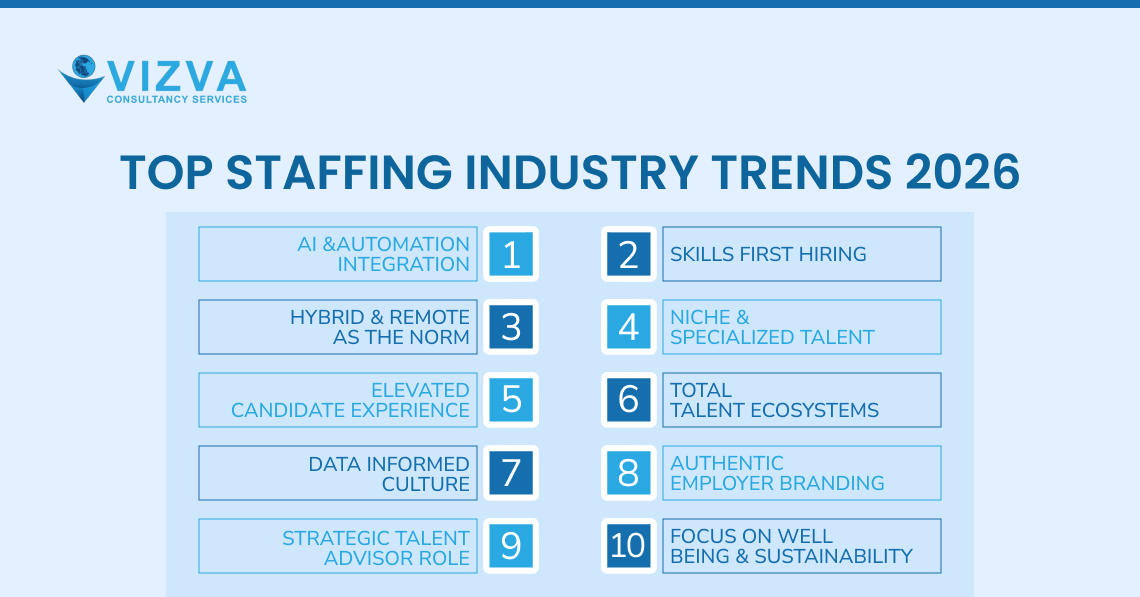
1. AI & Automation Integration
AI is already part of daily staffing work in 2026. Recruiters now use it for resume screening, candidate matching, interview scheduling, and even predicting hiring timelines.
The key shift this year is balance. AI facilitates speed and efficiency, whereas humans make the judgments, maintain contacts, and take the final decisions that the technology cannot replace.
2. Skills-First Hiring
The focus on the degree and job titles has reduced as the main criteria for hiring. Now companies prefer practical skills, real experience, and the most agile of mindsets.
Strategy increases the talent pool and raises the standard for hiring. In the year 2026, a candidate’s capability matters more than his/her background.
3. Hybrid & Remote as the Norm
Flexible work models are now normal. Most candidates expect hybrid or remote options as part of the job conversation.
Staffing today means matching roles with work-style preferences. Companies that are embracing the future of flexible work are the ones getting better employee engagement and higher employee retention over the long run.
4. Niche & Specialized Talent
Generalists’ work had been enough to hire for a time, but not anymore for businesses that want to grow. To keep up with the changing industries, companies now require highly specialized skills.
This made staffing firms push for deeper talent networks. Specialization in 2026 is a great way to minimize hiring risks and a fast win for placement success.
5. Elevated Candidate Experience
Candidates notice every detail of the hiring process. A company can lose valuable talent just because of a simple delay, lack of clarification, or silence after an interview.
This year, smoother processes and transparent conversations are more important. A good experience is a trust builder and a way of keeping candidates coming back.
6. Total Talent Ecosystems
Permanent, contract, freelance, and gig workers nowadays can be one talent strategy altogether. Companies are managing all talent types together, not separately.
In 2026, staffing partners help build flexible workforce models. This allows businesses to scale without losing control or consistency.
7. Data-Informed Culture
The decision to hire is increasingly based on data. To have an edge over competitors, companies today are following the trends of data uses, such as time to hire, skill demand trends, and employee performance data.
This shift helps reduce guesswork. In 2026, data supports smarter planning and better long-term hiring outcomes.
8. Authentic Employer Branding
Candidates want real stories, not fake promises. They want companies to show their strengths and weaknesses in their work culture, growth opportunities, and challenges.
This year, authentic employer branding attracts stronger talent. Being transparent builds credibility and helps companies stand out naturally.
9. Strategic Talent Advisor Role
Staffing firms are no longer just filling open roles. In 2026, they guide businesses on talent planning and future workforce needs.
Clients expect insights, market knowledge, and strategy. The recruiter’s role has evolved into a long-term talent partnership.
10. Focus on Well-being & Sustainability
Employee welfare has become one of the concerns rather than an afterthought. Candidates are genuinely concerned about work-life balance, mental health, and realistic workloads.
Sustainable hiring focuses on long-term success. In 2026, building healthy teams matters as much as filling positions quickly.
Staffing Trends: 2025 vs 2026
Aspect | Staffing In 2025 | Staffing In 2026 |
Artificial Intelligence | Used mainly for basic screening and automation. | Fully integrated to support faster, smarter hiring decisions. |
Skill-Based Hiring | Partially adopted alongside traditional criteria. | Skills-first hiring is the default approach. |
Work Flexibility | Offered selectively for certain roles. | Expected as a standard across roles. |
Market Stability vs. Reactivity | Hiring was mostly reactive and urgent-driven. | Hiring is planned, predictive, and data-led. |
Talent Strategy Focus | Focused on filling roles quickly. | Focused on long-term workforce building. |
What Is the Future of Staffing?
The future of staffing in 2026 is more strategic and skill-oriented. Companies do not limit their hiring to closing current gaps only. They are building teams based on future skills, adaptability, and long-term objectives.
Staffing today combines technology and human understanding. AI helps with speed and accuracy, while recruiters focus on people, culture fit, and career growth. This balance is shaping how hiring will work going forward.
Best Staffing Strategies 2026
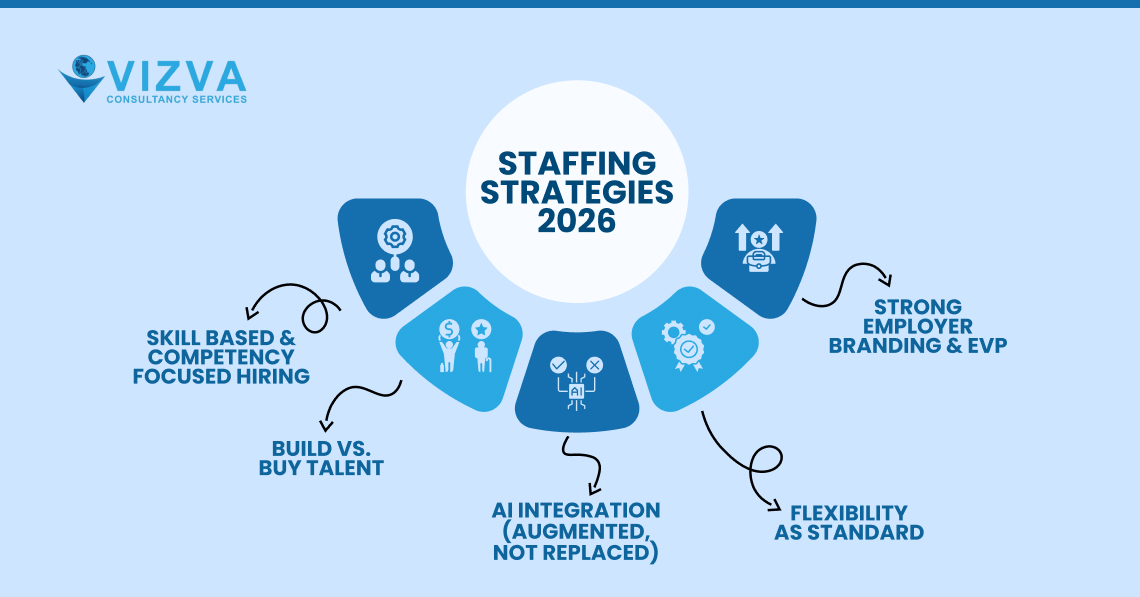
• Skill-Based & Competency-Focused Hiring
Hire based on real skills, not just degrees or job titles. This helps find candidates who can perform quickly and adapt to changing roles.
• Build vs. Buy Talent
Decide when to train existing employees and when to hire externally. A balanced approach saves costs and supports long-term growth.
• AI Integration (Augmented, Not Replaced)
Use AI to speed up screening and matching, but keep humans in control. Technology should support decisions, not replace judgment.
• Flexibility as Standard
Offer hybrid or remote work where possible. Flexibility attracts better talent and improves retention in 2026.
• Strong Employer Branding & EVP
Clearly communicate your culture, values, and growth opportunities. A strong EVP helps attract candidates who align with your business.
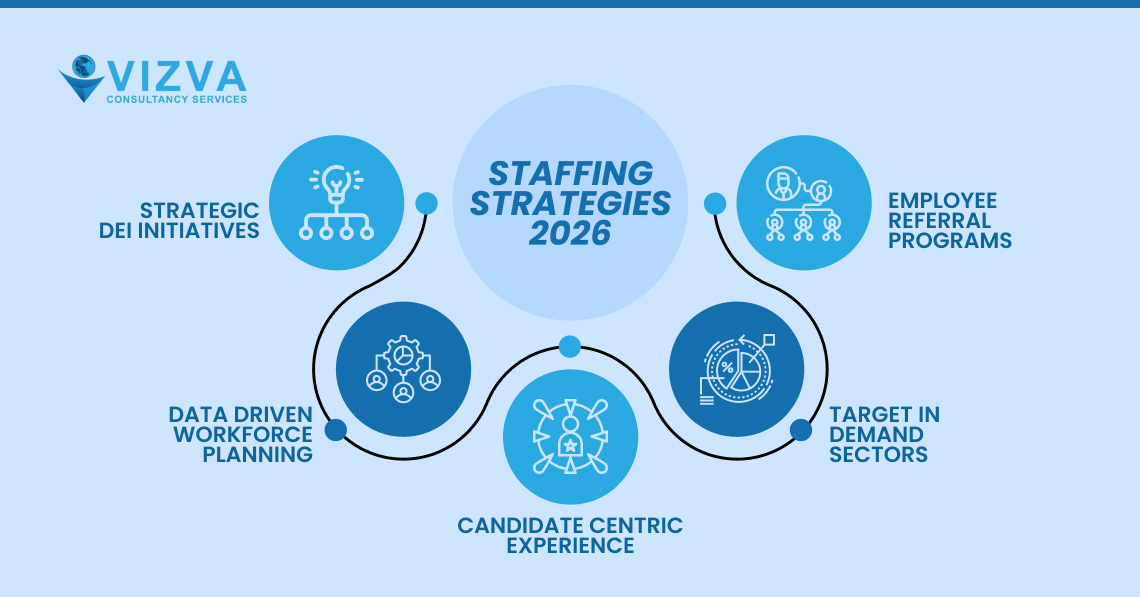
• Strategic DEI Initiatives
Focus on fair hiring and inclusive practices. Diverse teams bring better ideas and stronger business results.
• Data-Driven Workforce Planning
Use hiring data to plan ahead and reduce last-minute recruitment. Data helps predict needs and improve hiring outcomes.
• Candidate-Centric Experience
Keep the hiring process clear, fast, and respectful. A positive experience increases acceptance rates and employer trust.
• Target In-Demand Sectors
Focus hiring efforts on roles and industries with high demand. This helps stay competitive and reduce time-to-hire.
• Employee Referral Programs
Encourage employees to refer suitable candidates. Referrals often lead to faster hiring and better culture fit.
Conclusion
Staffing in 2026 is about preparation, not just reaction. Those companies that will be winners this year are the ones that concentrate on skills, adaptability, data, and people, changing swiftly in response to evolving talent expectations.
At Vizva Consultancy Services UK, we believe staffing should support long-term growth for both businesses and candidates. By combining smart hiring strategies, market insight, and a people-first approach, we help create hiring journeys that work today and stay relevant tomorrow.
Catch you in the next blog with more updates and insights.
Until then, keep these staffing trends in mind as you plan, hire, and build your teams in 2026.
FAQs
Q- What is the staffing industry forecast for 2026?
A- The staffing industry in 2026 is expected to grow steadily, driven by skills shortages, flexible work models, and digital hiring tools. Businesses are relying more on staffing partners for long-term workforce planning.
Q- What is the most in-demand job in 2026?
A- Technology, healthcare, and data-related roles remain the most in-demand in 2026. Jobs requiring AI skills, cloud expertise, cybersecurity knowledge, and healthcare specializations are especially sought after.
Q- Which job is best for the future in 2026?
A- Jobs that combine technical skills with adaptability are best for the future. Roles in AI, data analytics, healthcare, digital marketing, and skilled trades offer strong long-term potential.
Q- How will staffing change in the next decade?
A- Staffing will become more skills-driven, data-led, and flexible over the next decade. Technology will support hiring, while human insight will remain key in decision-making and relationship building.
Q- Is staffing a growing industry?
A- Yes, staffing is a growing industry in 2026 as businesses seek faster, flexible, and cost-effective hiring solutions. The demand for specialized and contract talent continues to increase across industries.
